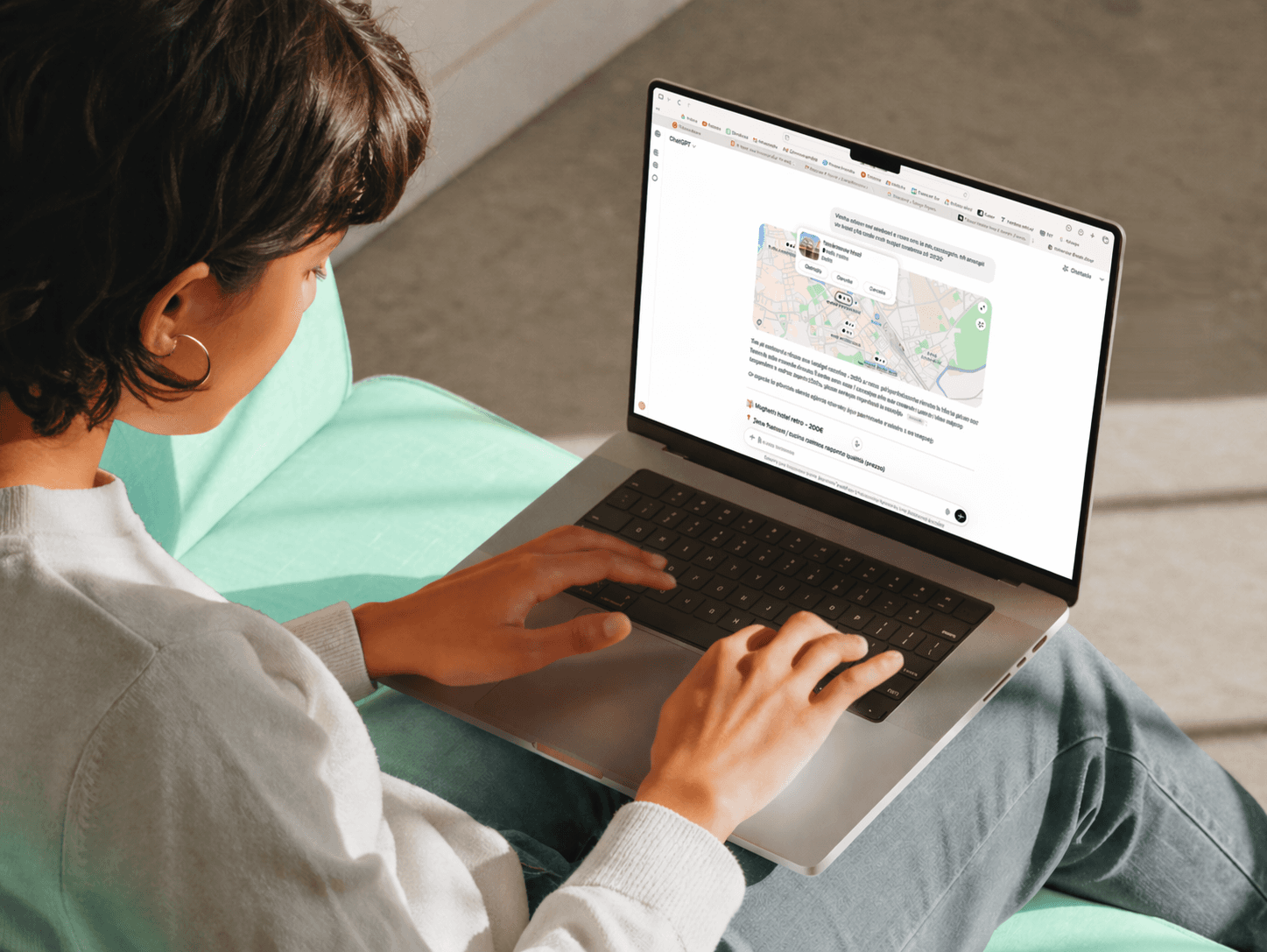
A new way to search for hotels
Until a few years ago, planning a stay meant comparing dozens of different platforms, opening hundreds of tabs, and reading thousands of reviews in search of the perfect place. Today, part of this journey is shifting elsewhere.
A growing number of travelers are opening ChatGPT, Gemini, or other AI tools and making precise, human-like requests-similar to what they would ask a person: "I’m looking for a hotel in Florence near the Uffizi, under €200, with breakfast included." In response, they receive a thoughtful and targeted selection of the best available options, complete with explanations and useful links.
This is no longer a marginal behavior. Data collected over the past year shows unprecedented growth, and hospitality is one of the sectors where this acceleration is most evident.
AI has already entered travelers’ decision-making process
Artificial intelligence is already involved in the inspiration, research, and evaluation phases of travel. According to Adyen, in 2025 one in three global travelers (34%) used AI to discover destinations, marking a +74% increase compared to 2024. Adoption is particularly strong among younger audiences, with Gen Z at 59% and Millennials at 48%, but it is also accelerating rapidly among older groups: Boomers and Gen X +98% year over year. The signal is clear: AI is no longer a marginal tool, but an increasingly central touchpoint in how users shape their travel decisions.
This behavior is already generating tangible traffic
When AI enters the decision-making phase, it stops being just a research tool and becomes a real gateway to hotel websites. This is exactly what data from Adobe shows: traffic from AI platforms to travel, leisure, and hospitality websites grew by +1,700% in February 2025 compared to July 2024, reaching 33x by May 2025. Adobe also identifies travel as one of the most impacted verticals by this trend, with stronger growth than retail and banking in the first comparable analysis. In other words: AI is already part of the decision-making process and is rapidly becoming a concrete discovery and evaluation channel for the travel industry.
 The traffic generated by AI platforms to travel, leisure, and hospitality websites grew by +1,700% between July 2024 and February 2025, reaching 33x by May 2025. Source: Adobe Analytics, March 2025
AI traffic is more valuable
Volume is not everything. The most relevant insight for the hospitality sector concerns what happens when AI-driven traffic reaches a website.
This behavior is also confirmed by conversion data analyzed by Semrush: a 2026 study indicates that visitors coming from AI platforms convert on average 4.4 times better than traditional organic search traffic. While values vary depending on sector and methodology-with some studies reporting lower or higher multiples-the overall trend appears consistent.
For the hotel industry, the data is particularly clear. A study by First Page Sage conducted on over 160 companies between May 2025 and February 2026 shows that hotels and resorts are the sector with the highest conversion rate observed from ChatGPT traffic, and with the widest gap compared to the organic channel:
 Visitors coming from ChatGPT have a higher conversion rate and a lower acquisition cost compared to traditional organic search traffic. Source: First Page Sage, February 2026
In practical terms, a visitor coming from ChatGPT converts at nearly double the rate of a visitor from organic search (+3.4 percentage points). This is the highest uplift observed in the study across all analyzed sectors.
The reason is structural. Someone asking an assistant to suggest a property with specific characteristics-location, price range, services-is not browsing; they are already narrowing down their choice. AI traffic, while still small in absolute terms, arrives very close to the moment of decision.
The AI assistant market is fragmenting
Until a year ago, talking about “AI traffic” essentially meant talking about ChatGPT. That is no longer the case. Data from Similarweb on global web traffic across major AI assistants shows a clear redistribution of market share between January 2025 and January 2026.
 Global web traffic distribution across major AI assistants (ChatGPT, Gemini, DeepSeek, Grok, Claude, etc.) in January 2026. Source: Similarweb, January 2026
In twelve months, ChatGPT’s near-monopoly has shrunk by more than 22 percentage points. Gemini has nearly quadrupled its share thanks to integration within the Google ecosystem (Search, Android, Workspace). Meanwhile, players such as DeepSeek, Grok, and Claude-which had negligible shares a year ago-have begun to occupy meaningful space.
The direction is clear: the market is not consolidating around a single system; it is fragmenting.
For the hospitality sector, the implication is direct: being visible only on ChatGPT will no longer be sufficient. Each assistant operates with its own logic (which sources it consults, which signals it prioritizes, how it formulates recommendations), and demand is spreading across an increasing number of environments.
How to interpret this data
These three data points, when read together, describe a radical shift unfolding on two levels.
Quantitative level A new channel is growing at a pace rarely seen in the travel industry. The current trajectory suggests that AI-driven traffic will soon represent a non-negligible share of hotel searches.
Qualitative level AI traffic reaches travelers at a different moment. In traditional search, discovery, comparison, and decision are separate phases. In conversational search, they tend to merge into a single interaction: the user defines constraints, receives already-filtered options, and chooses.
The implication for hospitality businesses is concrete
If a traveler starts from a question directed at an AI assistant, a hotel that is not mentioned-or is described inaccurately-remains excluded from the moment when the booking decision is formed.
To ensure your direct channel does not lose ground to OTAs in the AI-driven ecosystem, you need to prepare your data infrastructure today. You must ensure that when AI looks for reliable signals to recommend a hotel, yours is able to “speak its language.”
Is your infrastructure ready to provide precise answers and feed AI systems with real-time data, or will you allow OTAs to answer in your place?
Sources: Ahrefs - AI Traffic Research 2025 Adobe Analytics, march 2025 TakeUp - The Rise of AI-Planned Travel in 2026 Semrush - AI Search SEO Traffic Study First Page Sage - ChatGPT Conversion Rates: 2026 Report Similarweb - Global AI Tracker, january 2026 Search Engine Journal PPC Land Phocuswright - The AI Surge: Travel's Fastest Behavioral Shift in a Decade